Published Tuesday, January 27, 2026 in The Everett Herald
Snohomish Foundation's Trades Initiative Erases Training Barriers to Enter Workforce
By Michael Whitney
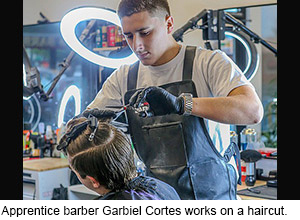
SNOHOMISH — For Garbiel Cortes to apprentice as a barber, getting the tools of the trade — from capes to clippers — cost money. The pro styling tools, over $1,000. The clippers, $300 each.
It all adds up, he said.
Through a grant program at the Snohomish Education Foundation, these were covered. It ensured Cortes, 19, had a smooth pathway to pursue his career.
"It really helped me out, because without that, I don't know if I could have started," Cortes said.
He's among a handful of students and recent graduates who the foundation's Trades Initiative has helped. Others are working toward careers as a skincare esthetician, a welder, an electrician, a veterinary assistant and more.
The foundation set up its Trades Initiative to help students get the equipment and associated training courses which not everyone can afford. For example, some job sites require bringing your own boots, safety equipment and basic tools to work. Another example could be giving a high school grad a computer to do school homework.
The foundation buys what is needed and hands those items to the grant recipient, Snohomish Education Foundation director Erica Cenci said. Who gets what is decided based on need and demonstrated proof the applicant is actively pursuing their selected trade.
Snohomish students and recent graduates can apply at any time. Grants come out quarterly. In June, the foundation spread $13,000 to five students.
A whole committee is behind this effort. A generous donor gave it momentum.
Ray Emery, who lives in the Snohomish area, approached the foundation merely asking how he could help. The Trades Initiative clicked.
"I'd like to support the kids like me who were not college bound," Emery, 84, said. He was an apprentice when he was just starting out.
He wanted to share how he became involved because it could inspire others to participate.
The "trades" are vast. The need is there.
"As Boomers are dropping off the workforce, we need people to replace them," Charlotte Murry, the head of the Snohomish & Island County Labor Council federation of local unions, said. "We're starting to see the pinch."
Within Snohomish County, the state Employment Security Department lists welders, aircraft technicians, auto service mechanics, auto body repairers, diesel specialists and electromechanical assemblers each as in-demand occupations locally right now.
Many of these roles require specific training. Some require vocational schooling.
Nationally, the U.S. Bureau of Labor Statistics anticipates a broad increase in the need for plumbers, electricians or HVAC technicians in the next eight years to replace workers who transfer to different occupations or retire or otherwise exit out of the labor force. The Bureau identifies the health care sector and clean energy installers are two of the few areas with even greater projected needs.
If you ask any business owner in the industries, they'd say they have a need for more skilled hands.
When employers say they can't find workers, though, it's because of a constricting effect of a local lack of projects as federal funds paused in recent years and Seattle's building boom softened, Murry said. One of the largest areas of unemployment currently is in construction.
Soon that may change, though: Murry points to major projects such as Sound Transit 3's Link Light Rail and the possibility of rehabilitating the U.S. 2 trestle that will need skilled workers of all stripes.
Building a future
The Snohomish Education Foundation offers 20 different trades-oriented scholarships, but this grants initiative it launched last year is a different.
Cenci said the foundation wants to connect with tradespeople to come speak to classrooms and give advice.
"We're building the program slowly but intentionally so it meets the needs of a lot of different industries and pathways while it still can be sustainable," Cenci said.
"I'm trying to get the people in place to build this," Cenci said. Emery designed his role to be simple: He told the foundation to find out what the graduates need and he'd commit money toward it.
This is his way to give the next generation of young adults their start, he said.
Cortes, the barber, now apprentices at Fade Lounge in Snohomish under the supervision of owner Silvio Garcia who is teaching hands-on lessons. The 1,200 hours of training will lead to a state barber license.
Cortes got on the barbering path by trying fades and taper cuts on his own head as a high school junior. Then, he gained the confidence to style other people's hair, he said. He plans to go fulltime.
"With the help of the Snohomish Education Foundation, it's taken a passion of mine and made it a reality," he said.
Apprenticeships are considered "earn while you learn" training programs.
The Labor Council points people to apprenticeships offered by unions. The average apprentice is 27 years old, Murry at the Labor Council said. She'd like to see people aged 18 to 24 come in the door.
These jobs won't be affected by AI, Murry said. "AI can't hammer a nail."
Ray’s story
Raised in western New York, Emery has always enjoyed making things with his hands.
His first job was with Motorola as a machinist at the plant in Arcade, New York, when the company made parts for the auto industry.
He apprenticed at Eastman Kodak, also in upstate New York, in tool and die making to make the molds for cameras.
Motorola came calling to hire him as a junior engineer, and taught him management.
Emery took every opportunity to learn.
He became the general manager of that Arcade, New York, plant at 36, then ran Motorola’s automotive division applying the production principles he learned over time.
Motorola sold the business to another company in 1988, and he stayed on as he felt ownership in its work and its people.
But Emery was also using his knowledge to teach classes in production efficiencies and organizational design — the architecture to align organizations to complement the company’s mission.
It was the early 1990s. Someone from Microsoft had flown to New York state to take his class. They saw opportunity, and told him they could use his services.
Microsoft was a small but growing company, but aspired to be global. That required being nimble when it wasn't.
At first, Emery resisted being headhunted. His knowledge base was manufacturing, not software. It took seeing Microsoft’s manufacturing factory in Bothell’s Canyon Park for Emery to say yes.
It brought his family to Washington state.
In a pre-broadband Internet age, software developers wrote computer programs, and their work was put on disks to be put in physical boxes to be shipped to retail stores. Any revisions or bug fixes meant all the software already boxed up needed to be pulled to be replaced with the latest version. It meant Microsoft had to have great quality control and be efficiently fast. Sort of Emery’s specialties in production processes.
Within six months, Microsoft entrusted him with handling the logistics, manufacturing and distribution of all its software made in multiple languages, which meant multiple manufacturing and distribution sites. He embedded a sense of ownership and quality within his staff.
His roles grew as the company did and he finished his career as Microsoft’s Vice President of World Wide Operations.
These days, Emery still works with his hands and tinkers on what needs to be done.
He tends a small backyard herd of Nigerian Dwarf goats. That’s for fun and leisure. The work never rests.